
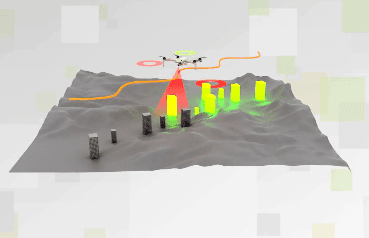
Vision Based Navigation
Back to Portfolio
AI & Navigation

Vision Based Navigation

AI-Powered Autonomous UAV Navigation in GNSS-Denied Zones

Project Overview

Unmanned Aerial Vehicles (UAVs) traditionally rely on GPS technology for navigation, however, when GPS signals are jammed or unavailable, the UAVs face significant limitations to perform intended functions. This necessitates the development of alternative technologies that enable UAVs to navigate and operate effectively in such environments. This project explores the potential of these technologies to create a robust navigation system that operates without reliance on GPS, focusing on the integration of image processing and AI-based solutions for real-time localization and navigation.

Image-based navigation overcomes the limitations of both GPS and inertial systems, providing accurate and reliable solutions in GPS-contested environments. This project seeks to build on these advancements to develop a reliable navigation system for UAVs when GNSS signals are compromised.

Vision Based Navigation Demonstration

Research & Development Approach

The necessary steps to achieve this objective are as follows:

1. Image Acquisition and Object DetectionCapture high-quality images of the environment using UAV-mounted cameras. Use AI models, such as YOLO, to detect and identify objects of interest in real-time. The detection process enables the UAV to identify landmarks and obstacles essential for navigation.
2. Real-World Coordinate CalculationDerive the real-world coordinates of detected objects using camera parameters and advanced algorithms. Employ triangulation and projection techniques to map image data into real-world space, enabling precise localization of objects relative to the UAV.
3. UAV LocalizationEstimate the camera/UAV's position in the environment by analyzing the spatial relationships between detected objects and their real-world coordinates. Integrate these calculations with onboard inertial sensors to enhance localization accuracy.
4. SimulationValidate the proposed system through initial simulations in Unity 3D to demonstrate feasibility.
5. Hardware ImplementationUpon successful simulation, implement the system on actual UAV hardware to test its performance in real-world GNSS-denied scenarios.

Flight Test Results

After successfully validating the concept through initial simulations in Unity 3D, actual flights have been executed using a DJI drone:

Drone flown in an L-shaped path for testing
Position compared using image output and IMU data
Successfully fused together using Kalman Filter (KF)
Error of only 5 meters at 500 meters flight height
Results compared with GPS coordinates and look encouraging
Stand-alone VBN system under development
Drone flight path and Kalman Filter results

Figure 1: Drone flight path and Kalman Filter fusion results

Outcomes & Impact

Achieved only 5 meters error at 500 meters flight height
Successfully demonstrated autonomous flight without GNSS
Validated concept through Unity 3D simulations
Executed actual flights using DJI drone
Foundation for stand-alone Vision-Based Navigation (VBN) system

Project Info

Client

PSDARC

Category

AI & Navigation

Key Features

YOLO-based real-time object & landmark detection
Real-world coordinate calculation using camera parameters
UAV localization via spatial relationship analysis
Kalman Filter fusion of image and IMU data
Unity 3D simulation for concept validation
DJI drone hardware implementation and flight testing

Tech Stack

PythonPyTorchYOLOOpenCVUnity 3DKalman FilterDJI SDK

Tags

Computer VisionDeep LearningIMU FusionAIGNSS-DeniedKalman Filter