
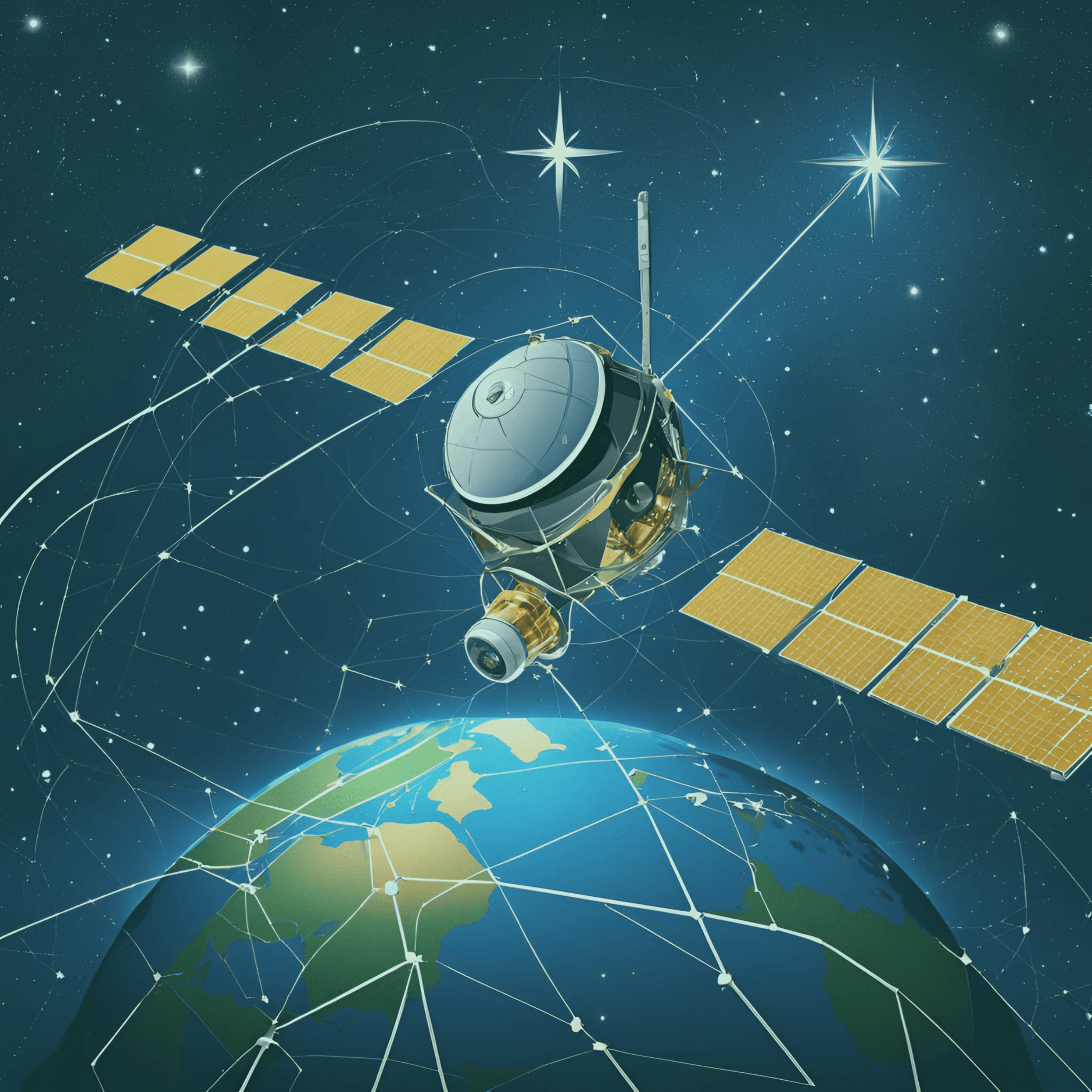
GNSS | The World of Navigation Technology
Understanding Global Navigation Satellite Systems
Global Navigation Satellite Systems (GNSS) has changed our navigation technology. Either you are using location on phone or using a self-driving car, GNSS plays key role in this. GNSS is a group of satellite system which gives positioning, navigation and timing (PNT) data.
Popular GNSS Networks
GPS (United States)
This is the most commonly used navigation system worldwide, providing reliable positioning for billions of devices.
GLONASS (Russia)
This system is known for its strong positioning capabilities, especially in high latitudes and remote areas.
Galileo (European Union)
This system focuses on accuracy and reliability, offering high-precision services for commercial and civilian use.
BeiDou (China)
This system expands global reach rapidly, providing comprehensive coverage across Asia and beyond.
Regional Systems
India's NavIC and Japan's QZSS are designed for specific regions, enhancing accuracy and reliability in their respective areas.
How GNSS Works?
GNSS technology uses network of satellites which are present in the orbit of Earth. These satellites broadcast signals that give exact time and location. GNSS receiver, like smartphone, analyze those signals and calculates the distance from satellite. By using minimum 4 satellite signals receiver get its exact position in form of latitude, longitude and altitude.
Applications of GNSS
Transportation
Enable GPS for cars, trucks and trains. Guide aircraft for flight and landing. Support maritime navigation of ships.
Agriculture
Optimization of resources like water and fertilizers for precision farming. Guide automated tractors for accurate planting and harvesting.
Construction and Surveying
Enhance land surveys with accurate positioning. Helps in machine control and infrastructure development.
Disaster Management
Provide real-time data for search-and-rescue operations. Helps in mapping and relief efforts for affected areas in case of natural disasters.
Recreational Use
Hikers and outdoor enthusiasts use this for navigation. Facilitates GPS-based activities like geocaching.
Innovations Driving GNSS Forward
The GNSS field is always evolving with new technologies and approaches.
Multi-GNSS Devices
Receivers that use signals from multiple GNSS systems improve their reliability and accuracy significantly.
Enhanced Precision
Methods like Real-Time Kinematic (RTK) and Precise Point Positioning (PPP) achieve centimeter-level accuracy for demanding applications.
Security Enhancements
Advanced anti-jamming and anti-spoofing technologies are becoming common to protect critical navigation systems.
AI Integration
The combination of GNSS data and AI enables smarter navigation and automation solutions across industries.
Environmental Applications
GNSS reflectometry is used to measure sea levels, soil moisture and deforestation rates for environmental monitoring.
Future of GNSS
The importance of GNSS technology is increasing day by day, as industries are integrating GNSS technology in new systems and processes. It is one of the main technology used in the innovation of self-driving cars, drone deliveries and smart cities. Also it become an important tool for sustainability and environmental monitoring.
At ZATNav (Pvt) Ltd., we specialize in delivering cutting-edge GNSS solutions, leveraging our expertise in signal processing and advanced hardware development. Our innovative offerings cater to a wide range of industries requiring precise navigation, robust anti-jamming capabilities, and enhanced signal integrity. For more information please feel free to contact us.